In This Article
- What Changed for Gambling Taxes in 2026 (and What Did Not)?
- Do I Owe Taxes If I Break Even on Sports Betting in 2026?
- When Is a Sports Bet Reported on Form W-2G in 2026?
- How Does New Jersey Tax Sports Betting Winnings in 2026?
- How Are Kalshi and Robinhood Prediction Markets Taxed?
- Is Using Crypto to Fund a Betting Account Taxable?
- How Do I Report March Madness Gambling Activity on My Tax Return?
- What Should I Do Right Now for 2025 Filing and 2026 Gambling Tax Planning?
- What Is the Legislative Outlook on the 90% Gambling Loss Cap and IRS Enforcement?
- Frequently Asked Questions
- Ready to File With Confidence?
Yes, all gambling winnings from March Madness 2026 are taxable. Starting this year, federal law limits your gambling loss deduction to 90% of losses (IRC Section 165(d), as amended by Public Law 119-21, Section 70114). Even break-even bettors may owe federal tax on "phantom income." New Jersey residents benefit from full 100% netting at the state level.
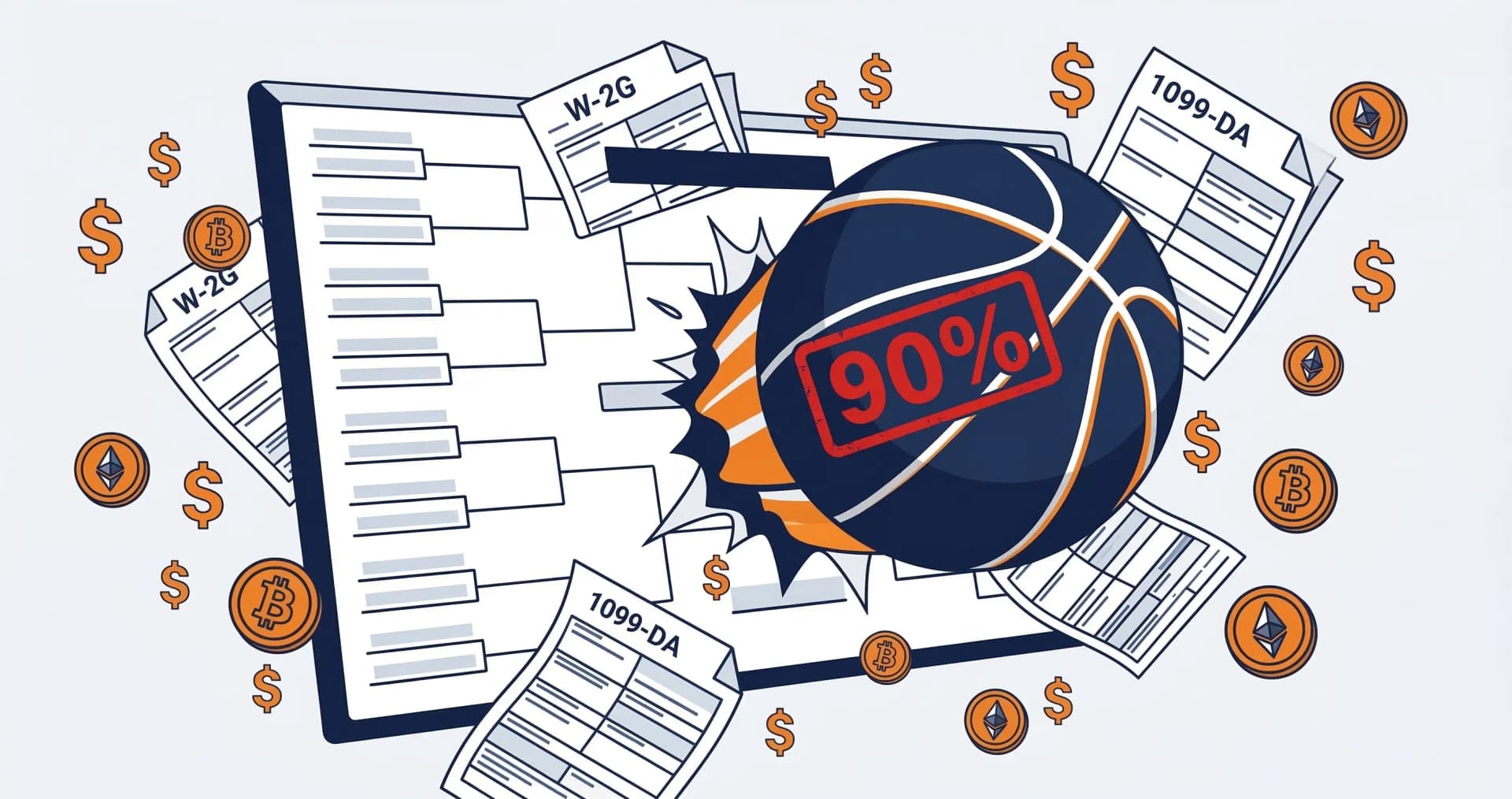
Congress changed the law, and starting with tax year 2026, breaking even on your March Madness bets can create federal taxable income. IRC Section 165(d) now limits wagering-loss deductions to 90% of losses, still capped by gains. Save this article.
The 2026 tournament was the first played under tax rules different from anything bettors have dealt with before - and those rules now apply to every bet you place for the rest of the year.
This is the first year of the 90% federal gambling loss cap under Section 70114 of the One Big Beautiful Bill Act (opens in a new tab) (OBBBA, Public Law 119-21), which amended IRC Section 165(d) (opens in a new tab). It is also the first March Madness where millions of people are placing real money on prediction markets through Kalshi, Robinhood, DraftKings Predictions, and FanDuel Predicts. Platforms the IRS has issued zero formal guidance on. And it is the first filing season where Form 1099-DA (opens in a new tab) exists, meaning crypto investors who fund gambling accounts with digital assets are sitting at the intersection of three separate, simultaneously active tax regimes.
Here is what most people are missing. These three areas (gambling, prediction markets, and crypto) do not stay in their own lanes. They interact. The same March Madness bracket can generate traditional sports betting income subject to the 90% cap, prediction market income with no settled IRS classification, and a crypto capital gain from the deposit you used to fund the account. All three are taxable. All three are reported differently. And all three can compound each other.
This guide covers how each one works, where they intersect, and what to do about it before December 31.
Scope note. This guide focuses on U.S. federal individual income tax rules for bettors and traders and highlights New Jersey where state rules differ. State treatment varies widely. If you are not a NJ resident, treat the NJ sections as examples, not rules for you. This article assumes you are a calendar-year taxpayer and discusses the 2026 tax year (returns filed in 2027) unless noted otherwise.
Key Takeaways: 2026 Betting Tax Changes
- The 90% cap. Federal law now limits gambling loss deductions to 90% of losses. Breaking even triggers taxable "phantom income." Effective January 1, 2026.
- W-2G changes. The sports wagering reporting threshold increases to $2,000 for 2026, but the 300-to-1 wager test still applies.
- NJ did not adopt the cap. New Jersey still lets residents net gambling wins and losses 100% on the state return.
- Prediction markets. IRS classification for Kalshi, Robinhood, and similar platforms remains unsettled. No Revenue Ruling, no Notice, no FAQ.
- Crypto funding. Selling or exchanging digital assets to fund a sportsbook or prediction market account is a taxable disposition requiring Form 8949.
- Standard deduction trap. If you take the standard deduction ($16,100 single / $32,200 MFJ for 2026), a casual (nonprofessional) gambler cannot deduct gambling losses federally. Professional gamblers report a qualifying trade or business on Schedule C, but the same 2026 Section 165(d) limitation still applies to wagering-loss deductions.
Your deposit-minus-withdrawal number is not your federal gambling income. The IRS requires you to report all gambling winnings (opens in a new tab), including winnings not shown on a W-2G. In 2026, even break-even activity can create taxable "phantom income" because wagering-loss deductions are limited to 90% and still capped at gains. Keep a simple log and download platform statements early.
In this guide:
- What Changed for 2026
- How the 90% Loss Cap Creates Phantom Income
- March Madness Mechanics: W-2G, Bonus Bets, Recordkeeping
- New Jersey's Gambling Tax Advantage
- Prediction Markets: What the IRS Has and Has Not Said
- Crypto Meets Betting: Digital Asset Tax Traps
- How to Report March Madness Activity on Your Tax Return
- Action Checklist: 2025 Filing + 2026 Planning
- Legislative Outlook and IRS Enforcement
- FAQ
What Changed for Gambling Taxes in 2026 (and What Did Not)?
The 90% loss cap. Effective January 1, 2026. Section 70114 of the OBBBA amended IRC Section 165(d) (opens in a new tab) so that losses from wagering transactions are deductible at 90% of the amount of such losses, and only to the extent of gains. Applies to all gambling activity in tax year 2026, filed in 2027. The old 100% rule still applies to 2025 returns (filed in 2026; extended returns due October 15, 2026).
The expanded definition. The statute defines "losses from wagering transactions" to include any deduction otherwise allowable that is incurred in carrying on wagering activity. This expanded definition mainly matters where a deduction would otherwise be allowed, such as a professional gambler's Schedule C expenses. Recreational bettors do not get a new federal deduction for handicapping subscriptions or research tools just because the statute broadened Section 165(d). If you are a professional filer, keep category-level records (wagers vs. platform fees vs. research tools) so your preparer can document what is included.
W-2G reporting threshold updates. For 2026, the applicable Form W-2G reporting threshold for sports wagering increases to $2,000. But sports wagering is not a flat "$2,000 equals W-2G" rule. Under the IRS's January 2026 instructions for Forms W-2G and 5754 (opens in a new tab), a sports wager must both (1) meet the applicable reporting threshold and (2) pay at least 300 times the amount wagered. The old $600 threshold is gone for sports wagers, but the 300-to-1 test remains. Identical wagers are aggregated for reporting purposes. For slot machines, the threshold rose from $1,200 to $2,000 with no odds test. This threshold will be inflation-indexed beginning in 2027.
Prediction market classification. Unresolved as of March 2026. The IRS has issued no Revenue Ruling, Notice, or FAQ on how to report Kalshi, Robinhood Prediction Markets, DraftKings Predictions, or FanDuel Predicts income. Three defensible approaches exist with wildly different tax consequences.
Form 1099-DA. Issued for the first time for Tax Year 2025. Under finalized Treasury regulations (opens in a new tab), brokers are mandated to report gross proceeds for sales executed in 2025. Mandatory cost basis reporting is delayed until January 1, 2026. If you used crypto to fund gambling accounts in 2025, you may have a capital gain on the conversion that needs to appear on Form 8949. Under IRS Notice 2024-57 (opens in a new tab), complex transactions like staking, wrapping, and liquidity pool lending are temporarily exempt from Form 1099-DA reporting. IRS Notice 2024-56 (opens in a new tab) provides penalty relief for brokers acting in good faith during this transition.
NJ rules. New Jersey does not enforce the federal 90% gambling loss cap. Under NJ Division of Taxation Technical Bulletin TB-20(R) (opens in a new tab) and N.J.S.A. 54A:5-1(g) (opens in a new tab), New Jersey continues to allow 100% netting of gambling losses against winnings on the NJ-1040, regardless of whether you itemize federally. A break-even bettor owes zero NJ gambling tax. NJ does not recognize a preferential long-term capital gains rate. Both of these facts matter more in 2026 than they ever have before.
Do I Owe Taxes If I Break Even on Sports Betting in 2026?
Key Terms
Phantom income is taxable income that does not correspond to actual economic profit. Under the 2026 OBBBA rules, phantom income arises when the 10% of gambling losses that are no longer deductible creates a positive taxable amount even for break-even bettors.
Session method is an IRS-proposed approach (Notice 2015-21 (opens in a new tab), not yet finalized) that allows netting wins and losses within a single continuous gambling session rather than reporting every individual bet. The guidance is most clearly developed for electronically tracked slot machine play.
Disposition is a sale, exchange, or other transfer of property that triggers a taxable event. Selling crypto to fund a sportsbook is a disposition.
Event contract is a binary contract that pays a fixed amount based on the outcome of a real-world event. Kalshi, Robinhood Prediction Markets, DraftKings Predictions, and FanDuel Predicts offer event contracts.
The Math of Phantom Income
Yes. Federal tax law now makes many "break-even" bettors taxable because the deduction for wagering losses is limited to 90% and still capped by gains. Congress, not the IRS, made this change through Public Law 119-21. The prior rule allowed 100% deductibility up to the amount of winnings. The new rule does not eliminate the deduction. It limits it.
Here is the math. If you win $20,000 and lose $20,000 during the tournament:
- Allowable deduction: $18,000 (90% of $20,000 in losses)
- Phantom taxable income: $2,000
- Federal tax at 24% bracket: approximately $480
You made zero profit. You still owe federal tax. The gaming industry and tax community call this phantom income: taxable income that does not represent actual economic profit. This is an illustration of the math, not a strategy. You cannot control your loss ratio in practice. The point is that break-even bettors are now taxable.
Phantom income scales with volume:
Read this before the table: these figures assume you itemize - the loss deduction only exists on Schedule A. If your gambling losses plus other deductions don't beat the standard deduction ($16,100 single / $32,200 MFJ for 2026), your real phantom income is bigger than shown: you'd take the standard deduction and pay tax on all your winnings. The table shows the BEST case for a break-even bettor.
| Winnings | Losses | Phantom Income | Fed Tax at 22% | Fed Tax at 24% | Fed Tax at 32% |
|---|---|---|---|---|---|
| $10,000 | $10,000 | $1,000 | $220 | $240 | $320 |
| $25,000 | $25,000 | $2,500 | $550 | $600 | $800 |
| $50,000 | $50,000 | $5,000 | $1,100 | $1,200 | $1,600 |
| $100,000 | $100,000 | $10,000 | $2,200 | $2,400 | $3,200 |
| $200,000 | $200,000 | $20,000 | $4,400 | $4,800 | $6,400 |
Phantom income stacks directly on top of your ordinary wages. If you are a single filer earning $120,000 from your primary employment and break even on $100,000 of sports betting, the $10,000 of phantom income is taxed at your marginal rate. At 24%, that is $2,400 out of pocket on zero net profit.
2026 Federal Marginal Tax Brackets (IRS IR-2025-103 (opens in a new tab)):
| Rate | Single Filers | Married Filing Jointly |
|---|---|---|
| 10% | Up to $12,400 | Up to $24,800 |
| 12% | $12,401 to $50,400 | $24,801 to $100,800 |
| 22% | $50,401 to $105,700 | $100,801 to $211,400 |
| 24% | $105,701 to $201,775 | $211,401 to $403,550 |
| 32% | $201,776 to $256,225 | $403,551 to $512,450 |
| 35% | $256,226 to $640,600 | $512,451 to $768,700 |
| 37% | Over $640,600 | Over $768,700 |
Your 2025 Return Is Not Affected
The 90% cap applies to tax years beginning after December 31, 2025. That means 2026 and later. Every dollar of gambling losses in 2025 is still deductible up to the amount of your winnings if you itemize. If you have not downloaded your 2025 year-end statements from every sportsbook you used, do that before you file. That deduction is real money and it disappears after this year.
Can I Deduct Gambling Losses If I Take the Standard Deduction?
No - not as a casual gambler. Casual (nonprofessional) gamblers can only deduct gambling losses if they itemize on Schedule A. Professional gamblers report a qualifying trade or business on Schedule C, where wagering deductions remain subject to the same 2026 Section 165(d) limitation. If you take the standard deduction ($16,100 single, $32,200 married filing jointly for 2026 per IRS IR-2025-103 (opens in a new tab)), you owe tax on gross winnings with zero offset. The 90% cap is an additional restriction on top of that.
Only about 10 to 14% of Americans itemize. The vast majority of casual March Madness bettors receive zero federal tax benefit from their losses regardless of the 90% cap. If a single taxpayer incurs $10,000 in gambling losses but has no other significant itemized deductions, their total deductions fall well short of the $16,100 standard deduction. They must claim the standard deduction, which means their gambling losses are entirely non-deductible. They still owe tax on their gross winnings.
Standard Deduction Trap. If you take the standard deduction ($16,100 single for 2026), a casual (nonprofessional) gambler cannot deduct gambling losses. Professional gamblers use Schedule C for a qualifying trade or business, but professional status does not remove the 2026 Section 165(d) cap. A casual gambler taking the standard deduction owes tax on 100% of gross winnings.
Do I Have to Pay Taxes on DraftKings Winnings?
How much tax do I owe on sports betting if I don't itemize? Most readers land here. If you win $5,000 on DraftKings during March Madness, lose $4,000, and take the standard deduction, your federal taxable gambling income is $5,000 (not $1,000). At a 22% bracket, that is $1,100 in federal tax with zero loss offset. The losses do not help you at all unless you itemize.
The SALT cap changes the itemizing math for some NJ residents. The OBBBA raised the SALT deduction cap. For 2026, the cap is approximately $40,400 for single and joint filers ($20,200 for married filing separately), indexed from $40,000 in 2025. This makes itemizing viable for more bettors in high-property-tax states like New Jersey. However, for taxpayers with modified AGI above $505,000 ($252,500 MFS), the $40,400 cap phases down at 30 cents per dollar above the threshold, to a floor of $10,000 ($5,000 MFS). The $505,000 threshold increases 1% annually through 2029. The elevated SALT cap reverts to $10,000 in 2030.
Senior bettors (age 65+). The OBBBA introduced a $6,000 senior bonus deduction for tax years 2025 through 2028 ($12,000 for joint filers where both spouses are 65+), phasing out at 6% of modified AGI above $75,000 single / $150,000 joint. For example, a senior with $100,000 MAGI would see the deduction reduced by $1,500 (6% x $25,000 over the threshold), leaving $4,500. If you are 65 or older, compare your standard deduction plus the senior bonus against your potential itemized deductions before assuming you should itemize just to claim gambling losses.
How Does the 90% Cap Affect Professional Bettors?
Professional gambler status (filing on Schedule C under Commissioner v. Groetzinger, 480 U.S. 23 (1987) (opens in a new tab); see also Mayo v. Commissioner, 136 T.C. 81 (2011)) does not exempt you from the 90% cap. Our tax preparation services cover both recreational and professional gambler filings. The OBBBA applies the limitation to all taxpayers who deduct gambling losses, whether recreational (Schedule A) or professional (Schedule C).
Here is the mechanical detail most people miss. Section 165(d), as amended for 2026, includes deductions otherwise allowable that are incurred in carrying on wagering transactions, so a professional bettor cannot escape the cap merely by labeling wagering-related costs as Schedule C expenses. Classification still matters: a buy-in or entry fee that constitutes a wager falls within Section 165(d), while a fee to enter a true prize competition may instead be an ordinary Section 162 expense when the trade-or-business requirements are met. Travel, lodging, software, research, and other costs require the same incurred-in-wagering analysis on their facts.
Example: a professional poker player generates $400,000 in gross winnings, incurs $390,000 in table losses, and has $50,000 in legitimate travel and business expenses. Combined losses and expenses total $440,000. The 90% cap allows a deduction of $396,000 (90% of $440,000). Because $396,000 is less than the $400,000 in winnings, $396,000 is the allowed deduction. That leaves $4,000 of taxable net income despite operating at a real-world financial loss of $40,000. Excess losses and expenses cannot be carried forward. They are permanently forfeited. Source: Foster Garvey analysis of OBBBA Section 70114 (opens in a new tab).
Professional gambling net earnings generally enter the Schedule SE computation under the prevailing IRS position. For an ordinary nonfarm business, Schedule SE generally multiplies business profit by 92.35% to determine line 4c net earnings, then applies the 12.4% Social Security component within the taxpayer's remaining 2026 contribution and benefit base of $184,500 and the 2.9% Medicare component without that cap; Form 8959 separately applies Additional Medicare Tax when combined wages, railroad compensation, and self-employment income exceed the filing-status threshold. That cost can offset the benefits of Schedule C treatment for moderate-volume gamblers.
When Is a Sports Bet Reported on Form W-2G in 2026?
For 2026, the applicable Form W-2G reporting threshold for sports wagering increases to $2,000. But a sports wager is not automatically reported just because winnings hit $2,000. Under the IRS's January 2026 instructions (opens in a new tab), a sports wager must both meet the $2,000 threshold and pay at least 300 times the amount wagered. Identical wagers are aggregated. The old $600 threshold is gone, but the 300-to-1 test remains for sports wagers.
That does not change your reporting obligation. Every dollar of gambling winnings is taxable regardless of whether you receive a form. The IRS requires reporting all gambling winnings (opens in a new tab), including winnings not shown on a W-2G. A W-2G is a reporting form, not a definition of what is taxable.
The $5,000 mandatory 24% federal withholding threshold remains unchanged, but for sports wagers, the IRS requires both gross proceeds (amount won reduced by the amount of the wager) exceeding $5,000 and a payout of at least 300 times the wager to trigger automatic withholding. Most standard sports bets will not have taxes automatically withheld. Budget for the tax.
Do Parlays Trigger a W-2G in 2026?
A parlay is treated as a single wager for W-2G purposes. The combined odds determine whether the 300-to-1 test is met. A $10 six-leg parlay that pays $5,000 meets both conditions ($5,000 exceeds $2,000 and 500:1 exceeds 300:1). Expect a W-2G. A $200 three-leg parlay that pays $2,100 meets the dollar threshold but not the odds test (approximately 10.5:1). No W-2G, but the income is still fully taxable and must be reported.
What Is the Difference Between Gross Winnings and Net Result for Tax Purposes?
Here is what a lot of recreational bettors get wrong. Your federal gambling income is not your deposit-minus-withdrawal number. It is the sum of every individual winning session or bet. If you place 150 bets during the tournament and win 65 of them, the IRS wants the total of those winning payouts reported as gross gambling income on Schedule 1. The losses offset that on Schedule A, subject to the 90% cap and only if you itemize.
Cross-platform netting. Yes - for wagering, you can offset DraftKings wins with FanDuel losses. The Section 165(d) computation is annual and across all your wagering activity combined: sportsbooks, casinos, and bracket pools, not per-platform. Prediction markets are the exception: because their classification is unresolved (see above), do not fold Kalshi-style contract results into your wagering totals by default. Track them separately and pick the reporting lane deliberately - if they are treated as gambling they join the netting; if they are property or Section 1256 contracts they follow completely different rules.
Can I Use the Session Method to Lower My Taxable Winnings?
IRS "session" guidance is most clearly developed for slot machine play, particularly electronically tracked slots. IRS Notice 2015-21 (opens in a new tab) describes a proposed safe harbor (not yet finalized) that allows netting wins and losses within a single continuous session of electronically tracked slot play. A session is defined as a continuous period of play at one game type, at one location, on one calendar day.
Extending session netting to sports betting app activity requires careful analysis and documentation and should not be assumed as a blanket IRS-approved rule. That said, many practitioners apply the session concept to online sportsbook activity on the basis that modern platforms electronically track every wager. If you use this approach, keep detailed records that clearly define your sessions and be prepared to defend the boundaries if audited.
Are Sports Betting Bonus Bets Taxable?
Yes. The full cash payout from a bonus bet is gambling income. Your cost basis in a promotional credit is zero because you did not pay for it.
Every sportsbook runs heavy sign-up promotions around big events like March Madness. Most bonus bets are stake-not-returned: when you win, you receive only the profit, not the original credit. Because you paid nothing for the promotional credit, the entire cash payout is gambling income.
A $200 bonus bet at +200 odds that wins pays $400 in cash (profit only; the $200 promotional credit is not returned). Your taxable winnings from that bet are $400. Track bonus bet activity separately in your log.
Chasing promotional bonus bets across multiple platforms significantly inflates your gross winnings, accelerating your exposure to the 90% federal loss cap.
When a Bet Settles, Not When You Place It
Gambling income is recognized in the year a bet settles, not the year you place it. A futures bet placed in December that resolves in April is a 2026 event. Open positions on December 31 are not wins or losses for that tax year. Same logic as selling a stock: the taxable event is the settlement, not the placement. (Exception: if you elect Section 1256 treatment for prediction market contracts, the mark-to-market rule requires you to treat open contracts as sold on December 31. See the prediction markets section below.)
What Records Should I Keep for an IRS or NJ Gambling Audit?
Date. Platform name. Ticket or transaction ID. Wager type. Amount wagered. Result. Payout received. Also keep: year-end platform statements (PDF), W-2G forms, bank deposit records, crypto exchange CSVs, and screenshots if the platform does not provide exportable data. The foundational recordkeeping standard comes from Revenue Procedure 77-29 (1977-2 C.B. 538) and is summarized in IRS Publication 529 (opens in a new tab). NJ Division of Taxation guidance also expects player card records, canceled checks, and platform statements.
How Does New Jersey Tax Sports Betting Winnings in 2026?
Does New Jersey Enforce the 90% Federal Gambling Loss Cap?
No. New Jersey does not enforce the federal 90% gambling loss cap. Under NJ Technical Bulletin TB-20(R) (opens in a new tab) and N.J.S.A. 54A:5-1(g) (opens in a new tab), New Jersey continues to allow 100% netting of gambling losses against winnings on the NJ-1040, regardless of the federal OBBBA limitation. A break-even bettor owes zero NJ gambling tax.
Using the same tournament example: win $20,000, lose $20,000. Federal phantom income is $2,000. NJ net gambling income is zero. NJ tax is zero on the same activity.
This is a meaningful structural advantage for NJ bettors in 2026 that did not exist the same way in prior years, because prior years did not have phantom income.
Does NJ Require Itemizing to Deduct Gambling Losses?
Federally, casual (nonprofessional) gamblers must itemize to deduct gambling losses. Professional gamblers report a qualifying trade or business on Schedule C, but their wagering deductions remain subject to Section 165(d). New Jersey uses a different method: you net wins and losses at the income line level on the NJ-1040, regardless of whether you itemize federally.
The Software Error That Costs NJ Bettors Money
NJ Software Warning. Check your NJ-1040 before filing. Many tax software programs incorrectly apply the 90% federal cap to the NJ return. NJ has its own rules and NJ allows full netting. If your software is applying the federal limitation to your NJ-1040 gambling line, you are overpaying state tax.
What Documentation Does NJ Require for Gambling Losses?
If you report net gambling winnings on the NJ-1040, you are required to attach a supporting statement showing total gross winnings and total gross losses. This is a NJ Division of Taxation requirement under TB-20(R). It is not optional. Casino "comp" letters estimating losses alone are not sufficient. Keep your platform year-end statements, player card records, and your own log available.
Does NJ Withhold State Tax on Gambling Winnings?
NJ may withhold state income tax on gambling winnings above certain thresholds (typically casino and lottery payouts). If NJ tax was withheld from your winnings, claim the credit on your NJ-1040. Online sportsbook payouts generally are not subject to NJ withholding unless they meet the W-2G threshold and NJ withholding requirements.
Federal vs. New Jersey: Side-by-Side Comparison
| Topic | Federal (2026) | New Jersey | What to Save |
|---|---|---|---|
| Loss limitation | 90% of wagering losses, capped by gains (IRC §165(d) (opens in a new tab)) | 100% netting of wins and losses (TB-20(R) (opens in a new tab)) | Year-end statements + your log |
| Itemizing required? | Yes, to deduct any losses (Schedule A) | No. Net at income line on NJ-1040; attach supporting statement | Supporting statement totals |
| Break-even bettor result | Phantom taxable income (10% of losses) | $0 NJ gambling income | Both federal and NJ calculations |
| Prediction market gains as capital | LTCG rate available if Section 1256 applies | No preferential LTCG rate; all gains taxed at ordinary rates up to 10.75% | Classification documentation |
| Capital loss carryforward | Yes (up to $3,000/year against other income) | No. Losses only offset same-category gains within the same tax year | Multi-year planning records |
What About Other States?
NJ is not the only state where the rules differ. Some states do not allow a federal-style itemized deduction for gambling losses. For example, Illinois does not allow gambling loss deductions (opens in a new tab). North Carolina's DOR explicitly states gambling losses are not included in allowable NC itemized deductions (opens in a new tab). Other states that restrict or prohibit gambling loss deductions as of 2026 include Connecticut, Indiana, Kansas, Ohio, Rhode Island, West Virginia, and Wisconsin (verify current-year conformity with your CPA, as state rules change). Massachusetts guidance states you cannot deduct losses claimed as itemized deductions on U.S. Schedule A; state treatment can be narrower and activity-specific. Michigan restored the loss deduction for casual gamblers under PA 168 of 2021, provided you itemize federally. Nine states with no broad-based income tax (Alaska, Florida, Nevada, New Hampshire, South Dakota, Tennessee, Texas, Washington, and Wyoming) impose no state gambling income tax at all. Your state of residence dramatically affects your after-tax outcome.
How Are Kalshi and Robinhood Prediction Markets Taxed?
What Is Different About Prediction Market Trading During March Madness
Millions of people are now placing money on tournament outcomes through prediction market platforms: Kalshi, Robinhood Prediction Markets, DraftKings Predictions, FanDuel Predicts. These platforms are distinct from sportsbooks. They use binary event contracts that settle to a fixed value based on real-world outcomes.
Here is the problem. The IRS has issued zero formal guidance on how to classify and report this income. Not one Revenue Ruling. Not one Notice. Not one FAQ. As of March 12, 2026, no consensus exists among tax practitioners.
This does not mean the income is not taxable. Under IRC Section 61 (opens in a new tab), all income from any source is taxable unless specifically excluded. Prediction market gains are not excluded. The unresolved question is how to report them and at what effective rate.
What Are the Different Tax Approaches for Prediction Markets (Ranked by Risk)?
| Tax Classification | Effective Tax Rate | Does 90% Cap Apply? | Can You Carry Losses? | NJ Effect | Audit Risk |
|---|---|---|---|---|---|
| Section 1256 (60/40) | Lowest (e.g., ~18.6% blended at a 24% ordinary / 15% LTCG profile; ~26.8% at the 37%/20% top brackets) | No | Yes (3-year carryback, but only against prior Section 1256 gains) | NJ taxes all at ordinary rates, no LTCG benefit | Highest |
| Gambling Income | Marginal rate (up to 37%) | Yes | No | NJ allows 100% netting | Moderate |
| Ordinary Income | Marginal rate (up to 37%) | No | Ordinary losses offset other income (different rules than capital losses) | Taxed at ordinary rates | Lowest |
Approach 1: Section 1256 Derivatives - highest audit risk, and only where the facts support derivative characterization.
The argument: Kalshi is a CFTC-designated contract market (DCM) (opens in a new tab). Section 1256 (opens in a new tab) contracts traded on CFTC-regulated exchanges receive 60/40 treatment (60% of net gains taxed at long-term capital gains rates, 40% at short-term rates, regardless of holding period). Losses can be carried back three years, but only against prior Section 1256 gains. The 90% gambling loss cap does not apply.
The risk: The IRS has not confirmed this. Because the CFTC categorizes event contracts as binary options (swaps) under 7 U.S.C. §1a(47) (opens in a new tab), the IRS has grounds to deny 1256 treatment based on the Dodd-Frank swap exclusion in IRC Section 1256(b)(2)(B). Treasury proposed regulations on this exclusion in 2011 (Federal Register 2011-23665) but never finalized them. If audited and the IRS disagrees, you owe back taxes, interest, and potentially penalties. File Form 8275 (Disclosure Statement) if you take this position.
Important Section 1256 mechanics. If you elect Section 1256 treatment, two additional rules apply. First, the mark-to-market rule under IRC Section 1256(a)(1) requires you to treat open contracts on December 31 as if they were sold at fair market value. Open positions are not "untaxed" under this approach. Second, the three-year loss carryback can only be used to offset prior Section 1256 gains, not ordinary income.
Form 8275 Warning. If you take the Section 1256 position on prediction market contracts, file Form 8275 to disclose the position. This does not prevent an audit, but it can protect you from accuracy-related penalties.
Approach 2: Gambling Income. Moderate Conservative.
If prediction market income is classified as gambling, the 90% loss cap applies. A break-even prediction market trader faces the same phantom income problem as a break-even sports bettor.
For NJ residents, this is the more state-aligned approach. Under NJ's full netting rule, NJ state tax on break-even prediction market activity could still be zero even if federal phantom income applies.
Approach 3: Ordinary Income. Most Conservative.
Report net gains as ordinary income on Schedule 1, Line 8z. Even here each contract needs its own theory - a winning contract's cost reduces the income you report, and a losing contract is deductible only under a provision that allows it (IRC Section 165(c)(2) profit-seeking transaction, a capital loss if the contract is property, or a Section 165(d) wagering loss subject to the 90% cap for 2026+). If you rise to trader-in-securities/commodities status, dispositions still go on Form 8949/Schedule D (capital) - or Form 4797 only with a valid Section 475 election - and Schedule C carries the trading business's expenses, not its gains (trading gains are generally not self-employment income). You pay at your marginal rate, you do not take an aggressive position, and your audit risk is minimal. If the IRS later clarifies that Approach 1 is correct, file an amended return and claim a refund.
Approach 3 is presented here as the conservative classification; the appropriate position remains fact-specific and is not a recommendation or promised result.
How Is a Sportsbook, Prediction Market, and Bracket Pool Taxed Differently?
| Factor | Traditional Sportsbook | Prediction Market (Kalshi) | Office Bracket Pool |
|---|---|---|---|
| Federal classification | Gambling income | Unsettled (3 approaches) | Gambling income |
| 90% loss cap applies? | Yes | Only if classified as gambling | Yes |
| Section 1256 (60/40) available? | No | Possibly (CFTC DCM status) | No |
| Loss carryback? | No | If Section 1256, yes (3 years) | No |
| W-2G issued? | If both $2,000+ and 300:1+ | No. Platforms do not issue 1099-B or W-2G for event contracts | No |
| NJ netting available? | Yes (TB-20(R)) | If classified as gambling, yes | Yes |
Does Kalshi or Robinhood Send a 1099 Tax Form?
Kalshi. CFTC-designated contract market. Kalshi does not issue a 1099-B for event contract trades. You must self-report using their year-end P&L statements. They do issue 1099-INT for cash balance interest at $10+ and 1099-MISC for referral credits of $2,000 or more for 2026 payments ($600+ applied through 2025, per OBBBA Section 70433). The Section 1256 argument is strongest here due to CFTC DCM status. File Form 8275 if you use Approach 1.
Robinhood Prediction Markets. Routes orders through Kalshi's exchange infrastructure (confirmed by Robinhood's March 2025 press release). Robinhood explicitly states it will not issue 1099s for event contract trades. They provide an Event Contracts Annual Statement labeled "not a substitute tax reporting form." Tax analysis follows Kalshi since they share the same exchange. In November 2025, Robinhood announced a joint venture to acquire MIAXdx, and the acquisition closed on January 20, 2026. Separate from its current Kalshi-linked offering, Robinhood has said the venture (now Rothera, LLC) is intended to operate a CFTC-licensed exchange and clearinghouse.
DraftKings Predictions / FanDuel Predicts. Both launched in December 2025 through CME Group exchange infrastructure. Track this activity separately from your standard sports bets on DraftKings and FanDuel. Do not aggregate them on your return. The IRS treatment is unsettled and the two product types (traditional sportsbook wagers vs. prediction market event contracts) have different reporting considerations.
Polymarket. Not a CFTC-regulated exchange. Polymarket International operates via smart contracts through Blockratize, Inc. (smart contract operator). Foreign-account reporting here is fact-specific. Under FinCEN Notice 2020-2 (opens in a new tab), a foreign account holding only virtual currency is not currently reportable on the FBAR unless it also holds other reportable assets. If your foreign platform account holds fiat currency or other specified foreign financial assets, FBAR and possibly Form 8938 (opens in a new tab) analysis may still be required. The income remains fully taxable regardless. Approach 2 (gambling) or Approach 3 (ordinary income) is the more defensible position.
The NJ Trap for Prediction Market Traders Using Section 1256 Treatment
If you use Approach 1 federally and report gains as Section 1256 contracts, you get the 60/40 split federally. NJ does not recognize a preferential long-term capital gains rate. NJ taxes all capital gains at ordinary income rates up to 10.75%.
NJ also does not allow capital loss carryforward. A losing year followed by a winning year creates a problem that does not exist under the gambling income approach: you absorbed the full loss in year one with no NJ offset and now owe NJ tax on the full gain in year two.
A $50,000 loss in one Kalshi year followed by a $50,000 gain the next results in zero federal tax (losses carried forward offset the gain) but potentially over $5,000 in NJ tax on that second year. The classification you choose has major NJ consequences completely separate from the federal analysis.
Is Using Crypto to Fund a Betting Account Taxable?
Yes. When you sell or exchange Bitcoin, Ethereum, or any other digital asset to fund a DraftKings account, a Kalshi account, or any other betting platform, that sale or exchange is a taxable disposition. You have sold the crypto. The gain (fair market value at the time of conversion minus your cost basis) must be reported on Form 8949 (opens in a new tab). Note that if funding involves a crypto sale or exchange, you have a reportable event. A simple wallet-to-wallet transfer of the same asset, without a sale, may not be. Source: IRS Virtual Currency FAQs (opens in a new tab).
Crypto Disposition Warning. Selling or exchanging crypto to fund a betting account is a taxable event BEFORE you place a single bet. The bet outcome is a separate tax event.
If you bought BTC at $30,000 and convert it to fund a March Madness account when BTC is at $85,000, you have a $55,000 capital gain on the crypto before you have placed a single bet.
Completed-transaction reporting. IRC Section 1091 currently does not apply the stock wash-sale rule to cryptocurrency. This is a description of current reporting mechanics, not transaction-timing or loss-harvesting advice; Monaco CPA does not recommend or monitor loss-harvesting transactions.
Receiving Crypto as a Payout Is Ordinary Income at Receipt
If you use Polymarket or any other crypto-native prediction market and receive USDC or another digital asset as your payout, the fair market value at the time of receipt is gambling income (or ordinary income, depending on which approach you use). If the crypto later appreciates and you sell it, that is a separate capital gain event with its own holding period and basis. Two separate taxable events from one payout. Document the receipt date and the fair market value on that date.
How to Avoid Overpaying on a 1099-DA With $0 or Blank Cost Basis
For the 2025 tax year (filed in 2026), cryptocurrency brokers are mandated to report gross proceeds, but cost basis reporting only becomes mandatory for covered digital assets acquired on or after January 1, 2026 (first appearing on Forms 1099-DA issued in early 2027). Pre-2026 and transferred-in lots remain noncovered, so blank basis persists. You will likely receive a Form 1099-DA displaying a $0 or blank cost basis.
There are two different situations here. If your Form 1099-DA does not report basis at all (blank), use the digital-asset "basis not reported" boxes on Form 8949: Box H for short-term or Box K for long-term. If the form reports a basis amount but it is wrong (including an incorrect $0 basis reported to the IRS), use the basis-reported boxes (Box G for short-term or Box J for long-term) and correct it with Adjustment Code B. Do not check "basis not reported" when the broker actually reported a number, even if that number is wrong. If you used a self-hosted wallet or offshore exchange and received no 1099-DA at all, use Box I (short-term) or Box L (long-term). Source: IRS Instructions for Form 1099-DA (opens in a new tab) and Form 8949 instructions (opens in a new tab).
For NJ filers, the phantom gain problem compounds at the state level. NJ taxes all crypto gains at ordinary income rates up to 10.75% with no preferential long-term rate and no capital loss carryforward.
Staking and DeFi Income in the Same Year as Gambling Wins
If you earn crypto through staking, mining, or DeFi protocol participation in the same year you have significant gambling income, all of it feeds into the same marginal rate calculation. Staking rewards are taxable ordinary income in the year of receipt under Rev. Rul. 2023-14 (opens in a new tab). Mining income is self-employment income or ordinary income depending on your setup. These income streams stack and can push you into a higher bracket. Mid-year planning, not April panic, is how you manage that.
How Do I Report March Madness Gambling Activity on My Tax Return?
| Activity | Form | Line | Notes |
|---|---|---|---|
| All gambling winnings | Schedule 1 | Line 8b | Include all, not just W-2G amounts |
| Gambling loss deduction (casual) | Schedule A | Line 16 | 90% cap applies; must itemize (professional gamblers use Schedule C, but the cap still applies) |
| Prediction markets (ordinary income) | Schedule 1 | Line 8z | "Other Income" |
| Prediction markets (Section 1256) | Form 6781 | Flows to Schedule D | Also file Form 8275 |
| Crypto disposition to fund account | Form 8949 | Flows to Schedule D | Separate from bet outcome |
| W-2G federal withholding | Form 1040 | Line 25c | Credit for taxes already paid |
| Estimated payments made | Form 1040 | Line 26 | Track quarterly |
| NJ gambling income | NJ-1040 | Line 24 | Net wins minus losses; attach supporting statement |
| Professional gambler | Schedule C + Schedule SE | SE tax applies under prevailing IRS position |
What Should I Do Right Now for 2025 Filing and 2026 Gambling Tax Planning?
Free Download: 2026 Gambling & Prediction Market Tax Tracker (Excel). Tracks sessions, sports bets, prediction markets, crypto dispositions, and W-2G reconciliation with auto-calculated 90% cap impact, Federal vs. NJ comparison, and estimated tax payments. Download the free 2026 gambling tax calculator.
Before you rely on the tracker: enter a losing bet's stake in the Losses column yourself - the current version does not auto-derive it from the Wager column. And because the tracker records session-level nets, New Jersey's supporting statement needs total winnings and total losses - so keep wager-level records too.
What Do I Need to Do for My 2025 Gambling Tax Return?
The 100% loss deduction still applies to your 2025 return. Every dollar left on the table here is gone permanently.
Download year-end statements from every sportsbook, casino, and prediction market platform you used in 2025. In DraftKings: Account, then Tax Center, then Download Year-End Statement. In FanDuel: My Account, then Tax Information. In Kalshi: Portfolio, then Statements. Compare supported Schedule A items with the applicable standard deduction. Gambling losses enter Schedule A only when the statutory requirements and substantiation rules are met; this is a return computation, not a promised saving.
Reconcile all W-2G forms. For 2025, the sports betting W-2G threshold was $600 at 300:1. If you hit parlays at those odds and amounts, forms were issued and the IRS has a copy.
If you traded Kalshi, Robinhood Prediction Markets, DraftKings Predictions, or FanDuel Predicts in 2025, report that separately from your sports betting activity. These are different tax events and the classification decision needs to be made intentionally, not by default.
If you converted crypto to fund any gambling or prediction market account in 2025, locate those transactions, reconstruct your cost basis, and report the gain or loss on Form 8949.
How Should I Track My 2026 Gambling Activity Starting Now?
Start a gambling log today. Date, platform, ticket ID, wager type, amount, result, payout. Bonus bets get a $0 cost basis and the full cash payout goes in the payout column. Prediction market trades go in a separate log from sports bets.
Track your gross win/loss trajectory quarterly. If you are approaching $25,000 in total gross activity by mid-year, contact a CPA before summer. After December 31, your options to manage phantom income are essentially gone.
Make estimated tax payments if your gambling activity is generating net income without withholding. For calendar-year taxpayers, estimated-tax payments are generally due April 15, June 15, September 15, and January 15 of the following year (dates shift if they fall on a weekend or legal holiday). NJ uses the same schedule on Form NJ-1040-ES. Source: IRS Estimated Tax FAQ (opens in a new tab).
Estimated tax safe harbor. You generally avoid the federal underpayment penalty if, after withholding and credits, you prepay the smaller of (1) 90% of your current-year tax or (2) 100% of your prior-year tax, rising to 110% if your prior-year AGI exceeded $150,000 ($75,000 MFS).
NJ residents: verify your tax software is not applying the 90% federal cap to your NJ-1040. This is a common error that results in overpaying state tax.
When Should I Hire a CPA for My Gambling Taxes?
If your total gambling and prediction market activity is heading toward $25,000 or more in 2026, the combination of the 90% cap, unresolved prediction market classification, and the NJ-federal divergence makes mid-year planning worth doing. Professional status is determined by the facts under Groetzinger; it is not an election made for a preferred result. The Section 165(d) treatment of wagering losses and expenses incurred in carrying on wagering transactions, together with the Schedule SE computation, can make the trade-or-business result worse than the recreational result depending on the facts. After December 31, planning options narrow significantly.
What Is the Legislative Outlook on the 90% Gambling Loss Cap and IRS Enforcement?
Will the 90% Cap Be Repealed?
The 90% cap has generated significant opposition. The American Gaming Association opposed it immediately. Representative Dina Titus (D-NV) introduced the FAIR BET Act (H.R. 4304) (opens in a new tab) to restore the 100% deduction, with 23 bipartisan co-sponsors as of March 2026. Related bills include the FULL HOUSE Act (Sen. Cortez Masto) and the WAGER Act (Rep. Andy Barr).
As of June 2026: none of these bills has passed. The 90% cap is current law for every bet placed in 2026. Plan under current law. If the law changes, amend the return. You cannot go back and reconstruct records you never kept.
Is IRS Enforcement on Gambling Income Increasing?
TIGTA reported that approximately 148,908 nonfilers were associated with roughly $13.2 billion of gambling winnings for tax years 2018 through 2020 (TIGTA Report 2024-300-064) and recommended notice-based enforcement, starting with higher-income nonfilers. The compliance environment is tightening, not relaxing.
What About Prediction Market Guidance?
The IRS has shown no signs of issuing formal guidance in the near term. Watch for Revenue Rulings, Notices, and CFTC regulatory developments. File conservatively, document thoroughly, and be prepared to amend if guidance changes the analysis.
Frequently Asked Questions
Does the 90% gambling loss cap apply to my 2025 return?
No. The 90% limitation applies to tax years beginning after December 31, 2025, meaning 2026 and later. Your 2025 return still uses the old 100% rule. Losses are fully deductible up to your winnings if you itemize.
Is every $2,000 sports-betting win reported on Form W-2G in 2026?
No. The $2,000 threshold applies, but the 300-to-1 wager test still applies to sports wagering. A sports bet must both meet the $2,000 threshold and pay at least 300 times the amount wagered to trigger a W-2G.
Do I still report gambling winnings if I do not get a W-2G?
Yes. The IRS requires reporting all gambling winnings, including winnings not shown on a W-2G. A W-2G is a reporting form. It does not define what is taxable.
Can I deduct gambling losses if I take the standard deduction?
No - not for a casual gambler. For casual (nonprofessional) gamblers, losses are only deductible if you itemize on Schedule A. Professional gamblers report a qualifying trade or business on Schedule C, but the 2026 Section 165(d) cap still applies. If you take the standard deduction, gross winnings are fully taxable with zero federal loss offset. NJ residents who take the standard deduction federally can still net losses against winnings on the NJ-1040.
How does New Jersey tax sports betting winnings?
NJ treats gambling as a net income category under TB-20(R). Residents net wins and losses at the income line level on the NJ-1040 regardless of federal itemization. NJ did not adopt the 90% cap. A break-even bettor owes $0 NJ gambling tax.
Are prediction market winnings taxable?
Yes. All income is taxable under IRC Section 61 (opens in a new tab) unless specifically excluded. Prediction market gains are not excluded. The unresolved question is how to classify and report them, not whether they are taxable.
How do I report Kalshi gains if I choose the ordinary-income approach?
Report each contract's result on Schedule 1, Line 8z (Other Income) - a winning contract's cost offsets the income, and a losing contract is deductible only under a provision that allows it (IRC Section 165(c)(2) profit-seeking transaction, a capital loss if the contract is property, or a Section 165(d) wagering loss subject to the 90% cap for 2026+ if you itemize). Reporting the result as ordinary income is the most conservative position and carries the lowest audit risk, but 'net everything on 8z' is shorthand, not authority.
How do I report Kalshi gains if I take a Section 1256 position?
Report on Form 6781, which flows to Schedule D. Also file Form 8275 (Disclosure Statement) to document your position. The IRS has not confirmed that event contracts qualify for Section 1256 treatment.
Does using crypto to fund a betting account trigger capital gains?
Yes. Selling or exchanging crypto to fund any account is a disposition of the digital asset. The gain or loss (fair market value at time of sale minus cost basis) must be reported on Form 8949 regardless of what happens with the bet.
If my 1099-DA shows $0 or blank basis, what Form 8949 box do I use?
Blank basis and $0 basis are not the same thing. If basis was not reported at all (blank), use Box H (short-term) or Box K (long-term). If the form reports a basis amount but it is wrong (including an incorrect $0), use Box G (short-term) or Box J (long-term) and correct with Adjustment Code B. If you received no 1099-DA at all (self-hosted wallet or offshore exchange), use Box I or Box L.
Can a foreign prediction-market account trigger FBAR or Form 8938?
A foreign prediction-market account may trigger FBAR or Form 8938 reporting, depending on whether it holds fiat currency. Under FinCEN Notice 2020-2, a foreign account holding only virtual currency is not currently reportable on the FBAR. If the account holds fiat currency or other specified foreign financial assets, FBAR and Form 8938 analysis may be required.
What are the 2026 estimated tax due dates?
For individuals: April 15, June 15, September 15, and January 15 of the following year. Dates shift if they fall on a weekend or legal holiday.
Do I need estimated tax payments if my sportsbook did not withhold?
Potentially. If you expect to owe $1,000 or more in federal tax beyond withholding, you are generally required to make estimated payments. Use the safe harbor: prepay the smaller of 90% of current-year tax or 100% of prior-year tax (110% if prior-year AGI exceeded $150,000).
Are staking rewards taxable?
Yes. Rev. Rul. 2023-14 concludes that cash-method taxpayers include the fair market value of staking rewards in gross income when they have dominion and control over them. That means upon receipt, not upon sale.
Should I wait to file prediction market income until the IRS issues guidance?
No. You have a filing obligation now regardless of guidance. File using the most defensible approach for your situation. If the IRS later clarifies the correct treatment, file an amended return.
What happens if I do not report gambling winnings?
TIGTA associated nearly 150,000 nonfilers with roughly $13.2 billion of W-2G-reported gambling winnings for tax years 2018 through 2020 (TIGTA Report 2024-300-064) - gross reported payments, not a measure of net unreported tax. The IRS has recommended stepped-up enforcement. Underreporting gambling income can result in penalties, interest, and in severe cases, criminal investigation.
If your total gambling and prediction market activity across sportsbooks, Kalshi, Robinhood, and other platforms is headed toward $25,000 or more in 2026, the combination of the 90% cap, unresolved prediction market classification, and the NJ-federal divergence makes mid-year planning worth doing. After December 31 your options narrow significantly. Get in touch before then. (opens in a new tab)
Greg Monaco, CPA, MBA is a NJ-licensed CPA focused on cryptocurrency and gambling taxation whose work has been cited by New Jersey CPA Magazine, Yahoo Finance, GOBankingRates, BeInCrypto, Better.com, and BlockTelegraph (with coverage syndicated to Nasdaq). He holds New Jersey CPA license and operates Gregory Monaco, CPA LLC (opens in a new tab) (New Jersey CPA firm registration), a virtual practice based in Livingston, NJ (Essex County). Full bio. (opens in a new tab)
Gregory Monaco, CPA LLC | Livingston, NJ 07039 | Written intake: contact form
MonacoCPA.CPA (opens in a new tab) | monacocryptotax.com (opens in a new tab)
This article is for general informational purposes only and does not constitute tax, legal, or investment advice. Tax outcomes depend on your specific facts and circumstances. Viewing this material does not create a CPA-client relationship. Personalized advice is provided only through a signed engagement letter. Written tax advice from a Circular 230 practitioner is governed by 31 C.F.R. §10.37.
Related reading: The 90% Gambling Loss Cap Is Here | How NJ Taxes Gambling Winnings | DraftKings and FanDuel Tax Guide for NJ | Prediction Market Taxes: Kalshi, Polymarket, Robinhood | The 1099-DA $0 Basis Trap | Gambling Tax Services | Crypto Tax Services
Ready to File With Confidence?
Tax rules change frequently. Use the contact form to request a written scope; submitting it does not promise a call, engagement, or outcome. Greg Monaco is a NJ-licensed CPA and the firm's sole practitioner.